

When golf courses purchase golf car fleets, they typically calculate the number of carts, their lifespan, maintenance costs, and rental revenue. However, with the introduction of connected screens and GPS fleet management systems, another value proposition is worth reassessing: a golf car that accompanies players for hours each day becomes a potential consumer touchpoint.
This doesn’t mean cramming the screen with ads. The real value lies in placing the right information when players are most likely to need it.
Sell at the Right Moment
One of the problems with on-course catering isn’t a lack of demand, but rather a mismatch between demand and service timing.
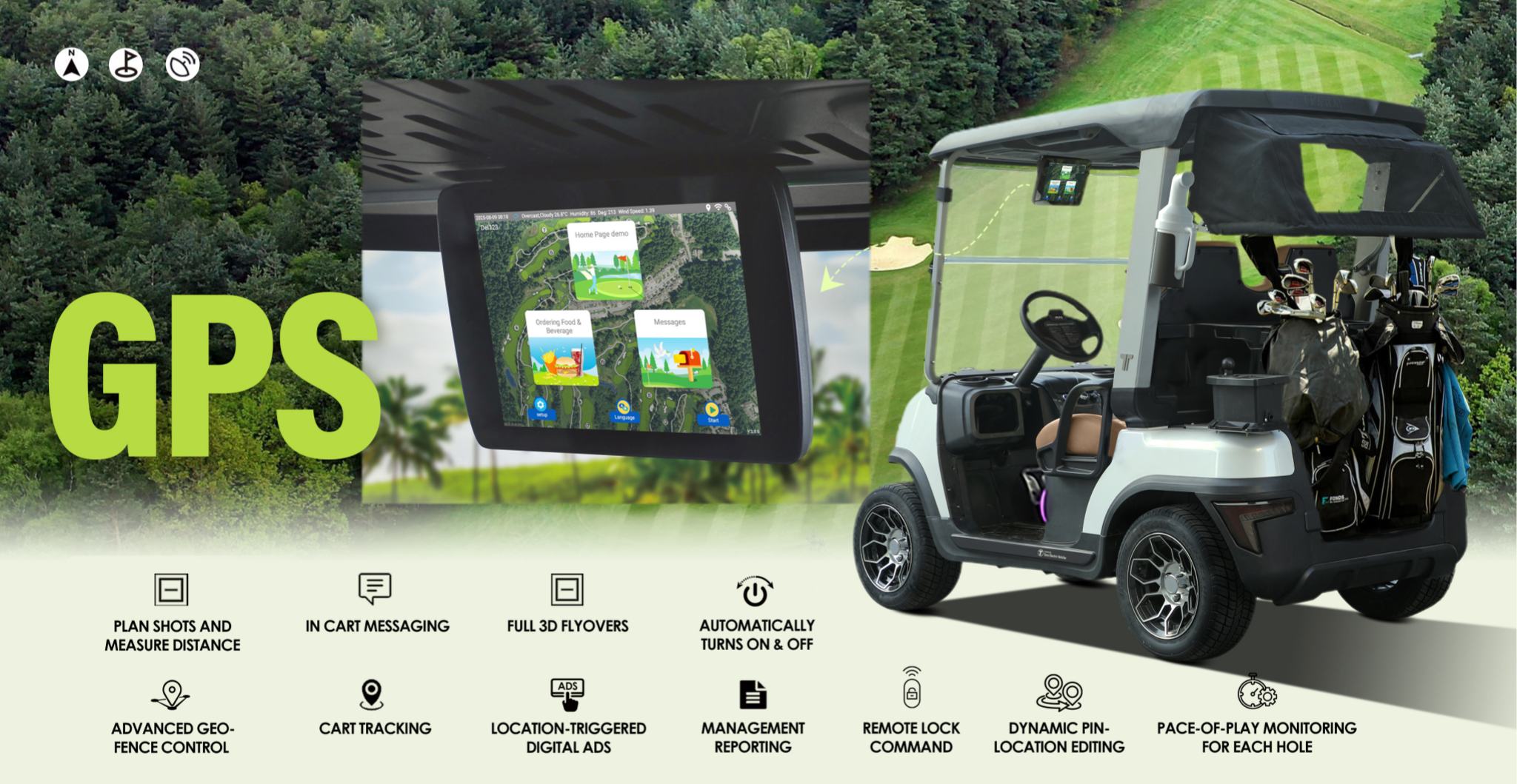
Previously, players would arrive at the halfway house and then start looking at the menu, queuing, and ordering, clashing with the pace of their matches. Onboard screens supporting F&B ordering change this process. Players can preview the menu and place orders in advance, allowing the catering team to prepare orders before their arrival.
This is the new business logic: instead of waiting for players to make purchases, courses can proactively present menus, set meals, or daily recommendations in appropriate locations.
For example, as the golf cart approaches the 8th or 9th hole, the system can push catering information, rather than displaying a quickly forgotten promotion as soon as the player tees off.
Screen Space Has Value
In-car screens have another easily overlooked asset: on-screen advertising.
Traditional golf course advertising is typically concentrated in the clubhouse, scorecards, hole markers, and during the tournament. Golf cart screens offer a different location—advertisements can accompany the player throughout the round.
The advertising content doesn’t necessarily have to come from external brands. The course’s own Pro Shop, new products, restaurant events, member events, Golf Lessons, or the next Tournament can all be displayed through in-cart messaging.
For golf courses with a stable customer base, this means the screen is not just a navigation device but can also perform some internal marketing.
Location Changes the Message
The real fun in-car marketing lies in GPS.
The same message has completely different value in different locations.
Near the halfway house, it can display F&B ordering; near the 18th hole, it can alert players to restaurants or the Pro Shop; during the tournament, it can display sponsor information; and upon entering a designated area, it can send event notifications.
Therefore, the course can connect each piece of content to the player’s current location.
This is also the biggest difference between regular digital advertising and Golf Cart GPS advertising: it knows where the golf cart is and maximizes the value of the advertising.
Measure More Than Cart Revenue
If a golf cart‘s value is only calculated based on rental income, its commercial value is easily underestimated.
A more comprehensive calculation should include whether the cart helps the course increase F&B sales, Pro Shop exposure, tournament sponsorship, and other on-course spending. Of course, not every course is suited to relying on advertising for direct revenue, but in-cart screens at least provide a ready-made communication channel without requiring players to download apps or actively search for information.
For the operations team, the more important question is no longer just “how many cars were rented out today,” but “what services can these carts connect to during a round of competition?”
From Fleet to Platform
Tara’s GPS Fleet Management System supports real-time cart tracking, geofencing, battery SoC monitoring, and pace of play management, as well as food and beverage ordering, in-cart messaging, and on-screen advertising.
Tara Golf Carts equipped with GPS can perform two tasks simultaneously: managing the golf cart fleet from the back end and serving as the entry point between players and course services from the front end.
For courses planning new fleets or upgrading their GPS systems, this also offers a new purchasing approach: in addition to comparing cart prices, range, and maintenance costs, it allows for an assessment of the additional value each cart can generate over its entire operating lifecycle.
A golf cart fleet operates on the course every day. How to utilize this time may be more worthwhile to explore than simply adding more promotional channels.
Post time: Jul-30-2026


