

Tourist courses have narrow roads with varying slopes, and vehicles frequently start and stop daily. A truly suitable golf course vehicle for long-term use needs to balance turf protection, quiet operation, vehicle turnaround time, and maintenance costs.
Turf Impact
Golf carts frequently traverse cart paths and parts of the green, so overall weight, tires, steering, and braking all affect usability.
Standard electric golf carts typically use low-pressure tires suitable for the course, reducing concentrated stress on the greens. After rain or when the greens are too wet, the course should still restrict vehicle access to sensitive areas. Even if the vehicle is well-suited to the course, it cannot replace normal course management.
Quiet Operation
Golf environments are sensitive to noise. Compared to gasoline-powered vehicles, electric vehicles eliminate engine idling and exhaust noise, making them more suitable for use near clubhouses, tees, and fairways.
Lithium golf carts also reduce maintenance tasks such as refilling traditional lead-acid batteries. For golf cart fleets that operate continuously every day, battery charging speed, actual range, and vehicle availability are more important than simply maximizing capacity.
Tara Electric Vehicles has over 20 years of experience in electric vehicle and lithium battery technology. Tara Golf Carts‘ course vehicles are lithium-ion powered and can be configured to meet various operational needs.
Vehicle Roles
A course typically requires multiple types of Golf Course Vehicles.
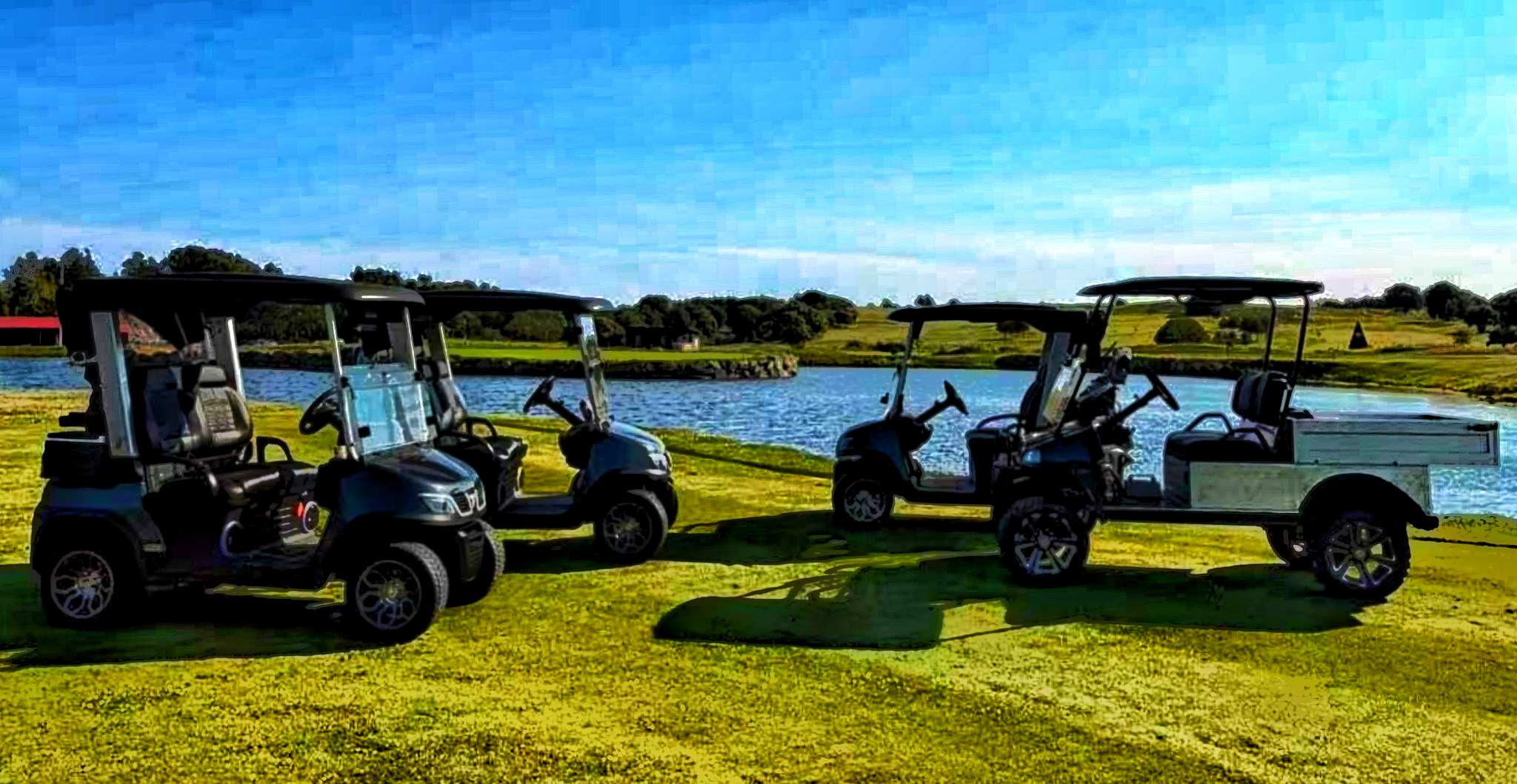
Two-seater vehicles handle player and bag transport; vehicles with caddie stands are suitable for caddie services; four-seater vehicles can be used for member reception and event personnel movement; and golf utility vehicles with cargo beds are better suited for turf maintenance, tool and material transport.
Tara Golf Carts offers two-seater models such as the Harmony, Spirit Pro, and Spirit Plus, as well as the Roadster 2+2, Explorer 2+2, and Turfman series. Assigning vehicles according to role reduces the need for player vehicles to be used for long-term cargo or reception duties.
Fleet Availability
When commercial courses purchase Golf Course Vehicles, maintenance, charging, and backup vehicles must also be considered.
If the fleet only has enough vehicles to meet peak demand, charging delays or malfunctions can disrupt normal tee-off schedules. Therefore, fleet planning needs to consider daily rounds, peak hours, charging windows, and the proportion of spare vehicles simultaneously.
GPS Management
When the number of vehicles reaches dozens or even hundreds, manual dispatching becomes less efficient.
Tara’s Golf Cart GPS can be used for real-time location tracking, geofencing, battery status, speed, fault codes, historical tracks, and Pace of Play management. Managers can view vehicle distribution and set rules for areas around the greens, pit lanes, or temporarily closed areas.
For large Golf Cart fleets, GPS is better suited as an operational tool than simply displaying maps to players.
FAQs
What vehicles are used on a golf course?
Common vehicles include two-seater Golf Carts, caddie carts, four-seater reception vehicles, and Golf Utility Vehicles. Different vehicle types are used for player transportation, reception, and maintenance, respectively.
Are electric golf carts better for golf courses?
With stable charging conditions, electric Golf Carts operate quietly and require less mechanical maintenance, making them ideal for golf courses.
Can golf carts drive on the fairway?
This depends on course regulations and the condition of the greens on the day. Some courses allow driving in designated areas, but restrictions such as Cart Path Only may be implemented after rain or when the grass is soft.
How many golf carts does a golf course need?
There is no fixed number. It usually needs to be calculated based on the number of rounds per day, peak demand, spare vehicles, and tournament usage.
What is a golf course utility vehicle used for?
A golf utility vehicle is primarily used for transporting vehicles, turf maintenance equipment, materials, and personnel, and is more suitable for routine maintenance work than a regular player cart.
Post time: Aug-14-2026


