

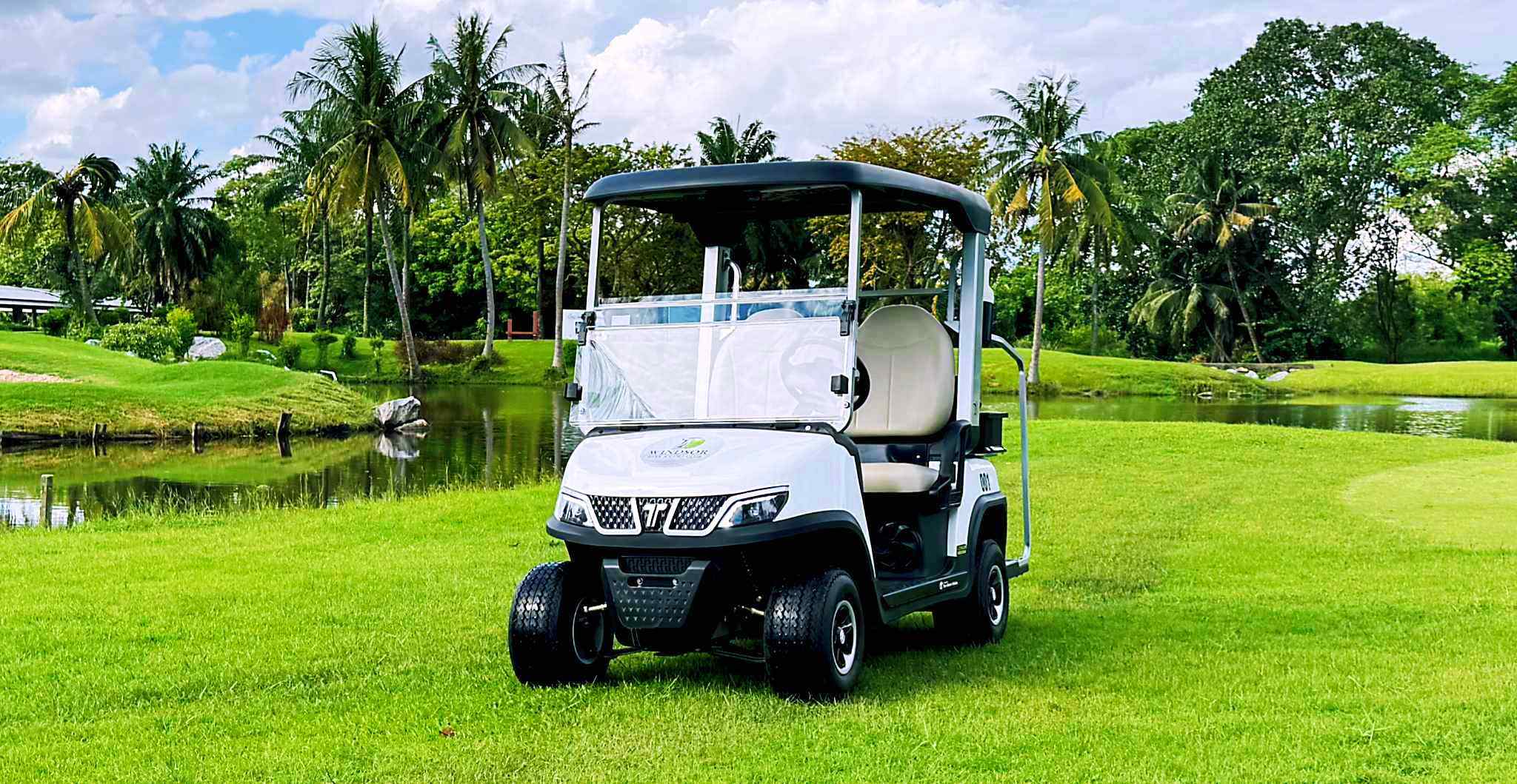
For golf courses offering caddie services, the “Golf Caddie Cart” is a common vehicle type. Unlike a manual push cart, the Golf Caddie Cart referred to here—such as the Tara Harmony—is a motorized golf cart equipped with a rear standing platform for the caddie. Capable of transporting both the player and the caddie, these carts have become an integral part of daily operations at many high-end clubs and tournament venues.
Compared to standard two-seater electric golf carts, the Golf Caddie Cart allows the caddie to travel alongside the vehicle, reducing the time spent walking back and forth and facilitating smoother communication between the player and the caddie.
Built for Caddies
Caddie services rely on efficiency and maintaining a good pace of play.
With its standing platform design, the Golf Caddie Cart eliminates the need for caddies to constantly get on and off the vehicle; they can quickly follow the cart between holes and immediately begin assisting upon arrival. This design is particularly well-suited for private clubs that uphold traditional caddie culture, high-end resort courses, and professional tournaments.
For the golf course, this not only boosts service efficiency but also enhances the member experience.
Daily Operation
A Golf Caddie Cart may need to operate continuously for several hours each day, making vehicle reliability crucial.
Increasingly, golf courses are adopting lithium-powered golf carts. Compared to traditional lead-acid models, lithium-ion versions offer faster charging and lower maintenance requirements, making them ideal for high-frequency operations.
For golf cart fleets intended for long-term use, a stable powertrain and mature lithium-ion technology can effectively reduce ongoing operational costs.
Fleet Management
As golf course fleets expand, vehicle management becomes increasingly important.
Many international golf courses have begun deploying GPS systems to centrally manage vehicle location, battery status, and usage patterns. Both standard golf carts and Golf Caddie Carts can be integrated into the same management platform, improving dispatch efficiency and simplifying future maintenance.
For large clubs, GPS management has gradually become a standard feature of modern golf cart fleets.
Why Tara Harmony
Tara specializes in the golf cart sector with over twenty years of industry experience; today, hundreds of golf courses and clubs worldwide utilize Tara golf carts.
Among them, the Tara Harmony is a Golf Caddie Cart specifically engineered for caddie service operations. The vehicle is equipped with a rear caddie stand platform; this ensures a comfortable ride for players while providing a safe, stable standing area for caddies, thereby better meeting the operational needs of high-end golf courses.
In addition to its proven lithium golf cart technology, Tara offers professional GPS solutions designed for golf carts. These systems enable vehicle tracking, geofencing, battery monitoring, and operational analytics, providing comprehensive support for fleet management.
FAQs
What is a Golf Caddie Cart?
A Golf Caddie Cart is a golf cart featuring a caddie stand platform. Designed to serve both players and caddies simultaneously, it is primarily used at high-end golf courses that offer caddie services.
Why do golf clubs use Golf Caddie Carts?
They reduce the walking distance for caddies and improve service efficiency, while also facilitating smoother coordination between players and caddies; consequently, an increasing number of high-end courses are adopting this type of vehicle.
Are lithium golf carts suitable for golf course fleets?
Yes. Lithium golf carts offer longer battery life, faster charging speeds, and lower maintenance requirements, making them ideal for golf cart fleets subject to frequent daily use.
Does Tara offer GPS fleet management?
Yes. Tara provides professional GPS systems for golf carts that help courses manage their entire fleet—including Golf Caddie Carts—thereby enhancing operational efficiency and management standards.
Post time: Jul-21-2026


